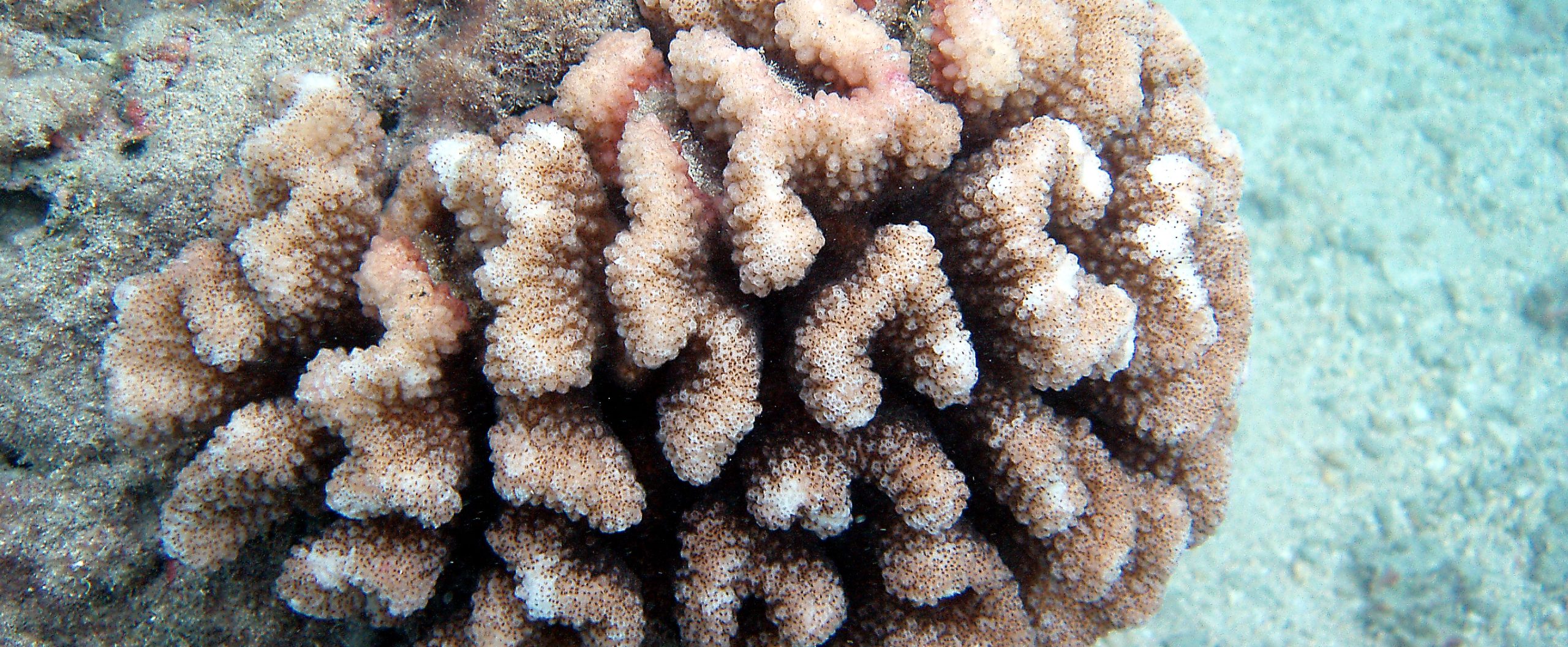
Cauliflower Coral in Hanauma Bay – Photo credit: Larry Winnik, contribution to the Dear Ocean Digital Coral Ark (2005)
The Future of Hanauma Bay: Understanding Cauliflower Coral Spawning
Cauliflower coral (Pocillopora meandrina) is a distinctive and vital part of Hanauma Bay’s underwater ecosystem. This coral species is easily recognized by its intricate, branching structure that resembles the florets of a cauliflower. Its polyps are often pinkish-brown to greenish, adding a splash of color to the reef.

Cauliflower Coral in Hanauma Bay – Photo credit: Larry Winnik, contribution to the Dear Ocean Digital Coral Ark (2014)
Cauliflower coral lives in the shallow, sunlit waters of Hanauma Bay. Its colonies form dense clusters that provide essential habitat and shelter for a variety of marine organisms. The distribution of cauliflower coral across Hanauma Bay not only enhances the reef’s structural complexity but also contributes significantly to the overall biodiversity of this protected marine sanctuary. Unfortunately, like many other near-shore reef species, cauliflower coral is under significant threat from multiple stressors, leading to a decline in the number and health of the colonies. The nonprofit, Dear Ocean, has collected thousands of historical photographs of cauliflower coral in Hanauma Bay for its Digital Coral Ark project, including several thousand time-series photographs of 28 coral colonies shown on an interactive ArcGIS map.
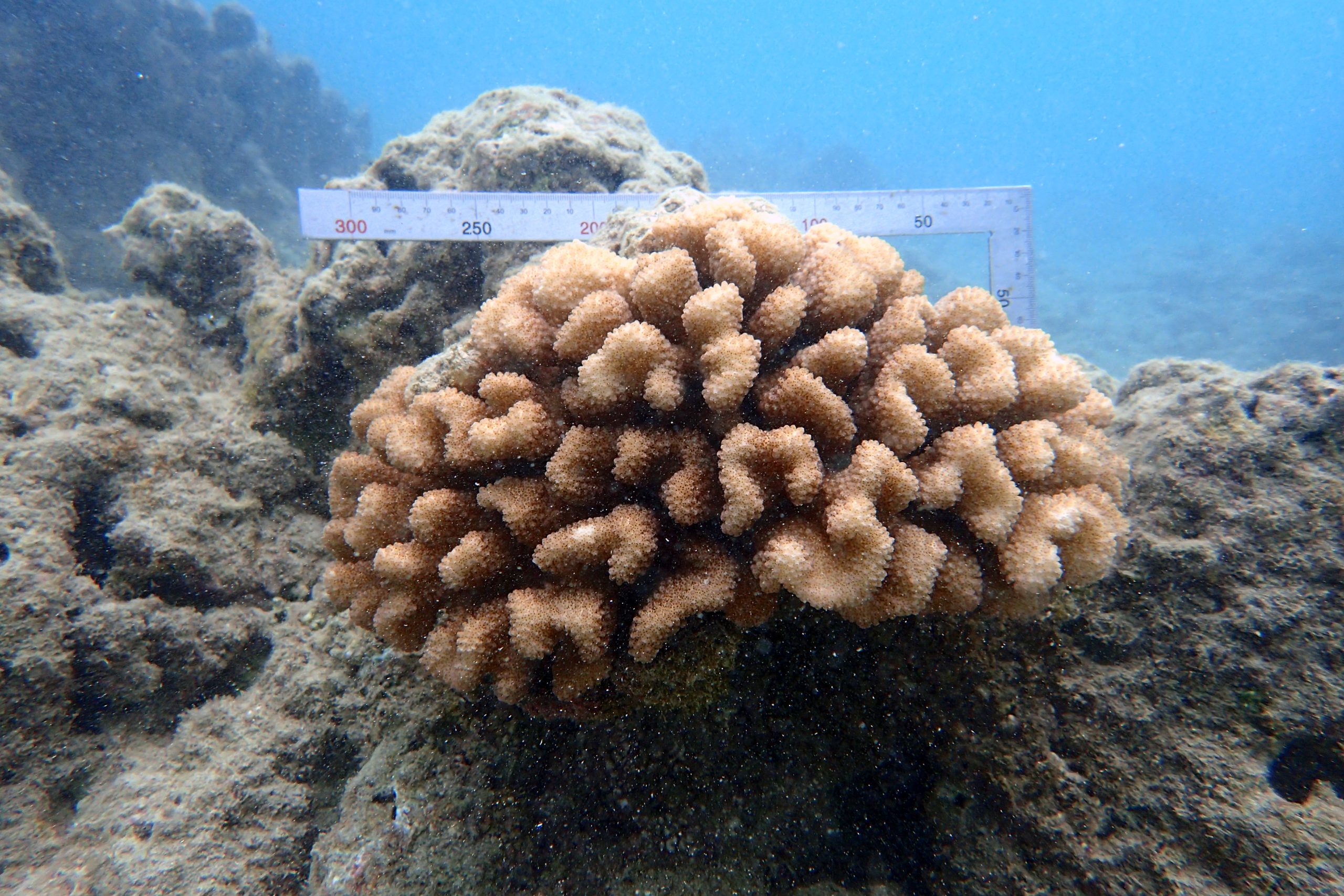
Cauliflower Coral in Hanauma Bay – Photo credit: Anke Roberts, contribution to the Dear Ocean Digital Coral Ark (2021)
But each Spring, cauliflower corals spawn throughout the Hawaiian Islands, which is a joyful event that gives us hope for the future of our Hawaiian reefs. During this time, corals simultaneously release eggs and sperm into the water column, allowing for external fertilization. Following the spawning event, the fertilized eggs develop into planulae (a type of larvae), which eventually settle onto the reef and grow into new coral colonies. This process is crucial for the reef’s health and sustainability, ensuring the regeneration and continuation of coral populations.

Coral Spawning on Hawaiʻi Island – Photo Credit: Dear Ocean (2024)
You can watch a video and read more about the spawning event above on a virtual guided exploration of a cauliflower coral spawning event on the Kona Coast of Hawaiʻi Island.
Healthy coral populations provide essential habitats and protection for a myriad of marine species, supporting biodiversity. Additionally, coral reefs act as natural barriers that protect coastal areas from storm surges and erosion. So, it’s easy to see that the successful spawning and recruitment of cauliflower coral are vital for maintaining the ecological integrity and resilience of reef ecosystems around Hawaiʻi.
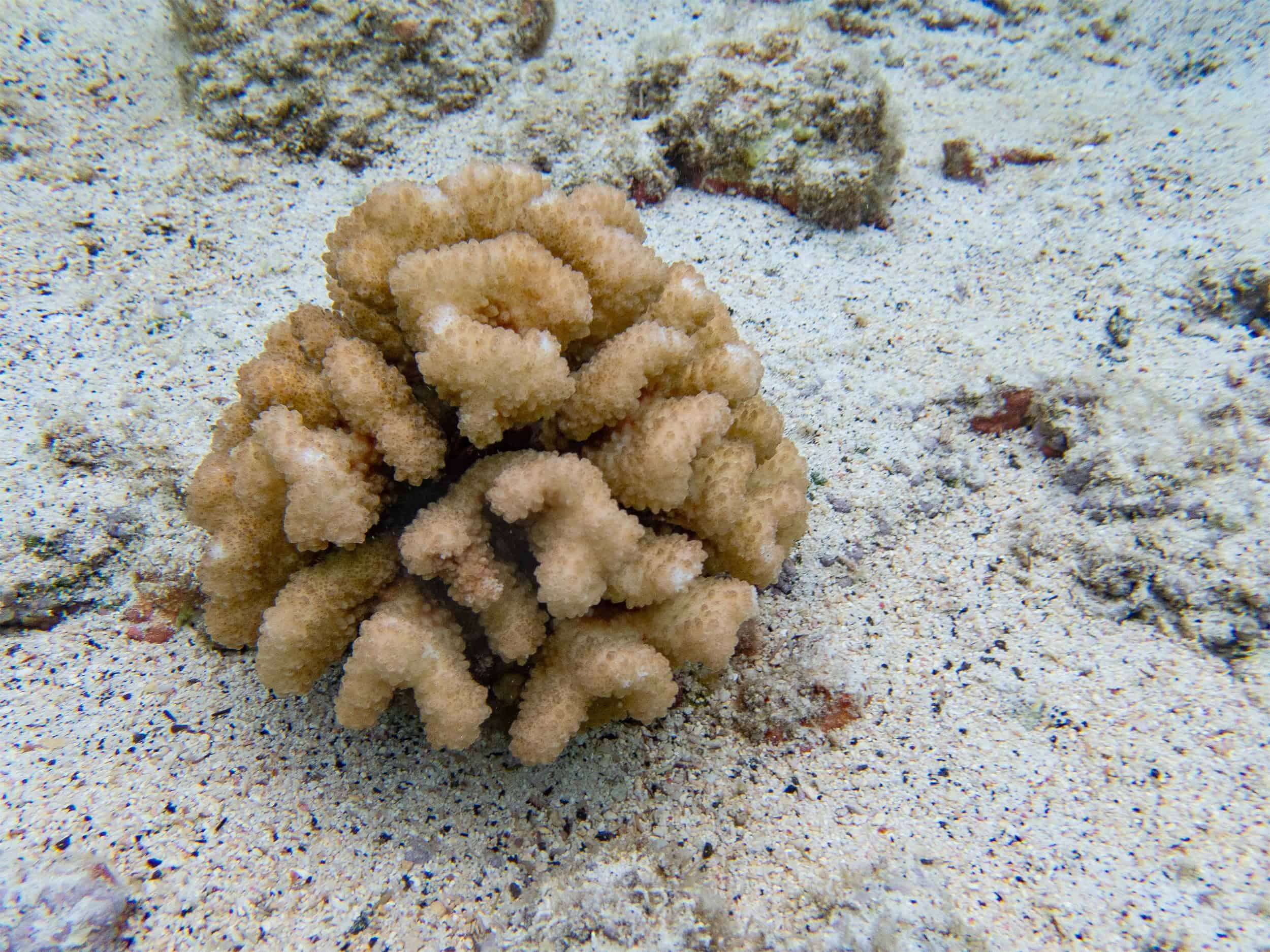
Young Cauliflower Coral Colony in Kahaluʻu Bay – Photo credit: Dear Ocean (2022)
Therefore, it is crucial for NGOs and government agencies to collaborate closely to implement effective conservation strategies. This type of partnership can ensure the protection and sustainability of these vital spawning events, safeguarding the future of Hanauma Bay’s coral reefs.
One outstanding model for this is Kahaluʻu Bay, where local community stewardship, ReefTeach, has worked closely with the County of Hawaiʻi to temporarily close the beach park during critical cauliflower coral spawning events. According to Cindi Punihaole, Director of the Kahaluʻu Bay Education Center, cauliflower coral was once abundant on shallow coral reefs along West Hawaii, including Kahaluʻu Bay. However, environmental stressors and very high ocean temperatures impacted West Hawaii in 2015 and again at the end of 2019, causing catastrophic bleaching and mortality for more than 90% of the Kahaluʻu Bay population. Working with DAR and Eyes of the Reef, KBEC determined the exact dates and time frames when the cauliflower corals would spawn.
Each year KBEC works closely with the County of Hawaii Parks director to recommend the best closure dates for cauliflower coral spawning at Kahalu`u Beach Park. Removing human activity and chemical sunscreen from the bay allows coral larvae to find suitable places to settle and grow without interference. This year, The Hawaiʻi County Department of Parks & Recreation announced the closure of Kahaluʻu Beach Park from May 23 to May 31, 2024.

Cauliflower Coral Spawning in Kahaluʻu Bay – Photo credit: Brianne Lauro
“Kahaluʻu Bay receives over 400,000 visitors a year to our small 4.2-acre county park. Kahalu`u Bay ReefTeachers engage and educate the visitors with Aloha so they become part of the solutions. Once educated, they are very respectful and try their very best to be pono (proper).” – Cindi Punihaole
By working together, state and local governments can pool resources and expertise with scientific and community stewardship organizations to address the threats facing cauliflower coral events and promote the health of the entire marine ecosystem.
CALLING UNDERWATER PHOTOGRAPHERS!
We are seeking contributions to the Hanauma Bay Digital Coral Ark project that:
- have sufficient clarity and resolution to visually identify species of fish and/or coral.
- can be identified by date and location (either by personal knowledge or embedded camera data).
- are owned by adults 18 years+ willing to grant permission to use in the historical database.
- are from any previous time, but especially those taken prior to 2016.
You can either use Dear Ocean’s Contributor Page to upload directly or reach out via the Contact form to receive a portable thumb drive to share larger collections.
Past Media Coverage of Kahaluʻu Beach Park Coral Spawning Closures from 2018 – 2024:
- https://www.bigislandvideonews.com/2018/04/27/coral-spawning-event-to-close-kahaluu-beach-park/
- https://www.kona-kohala.com/news/details/kahaluu-bay-closure-set-for-coral-spawning-may-28-june-5
- https://www.bigislandvideonews.com/2022/04/21/kahalu%ca%bbu-beach-park-to-close-in-may-for-coral-spawning/
- https://www.khon2.com/big-island-news/kahaluu-beach-park-to-close-for-coral-spawning/
- https://www.bigislandvideonews.com/2020/05/09/kahaluu-bay-coral-gets-rest-spawning-expected-this-week/